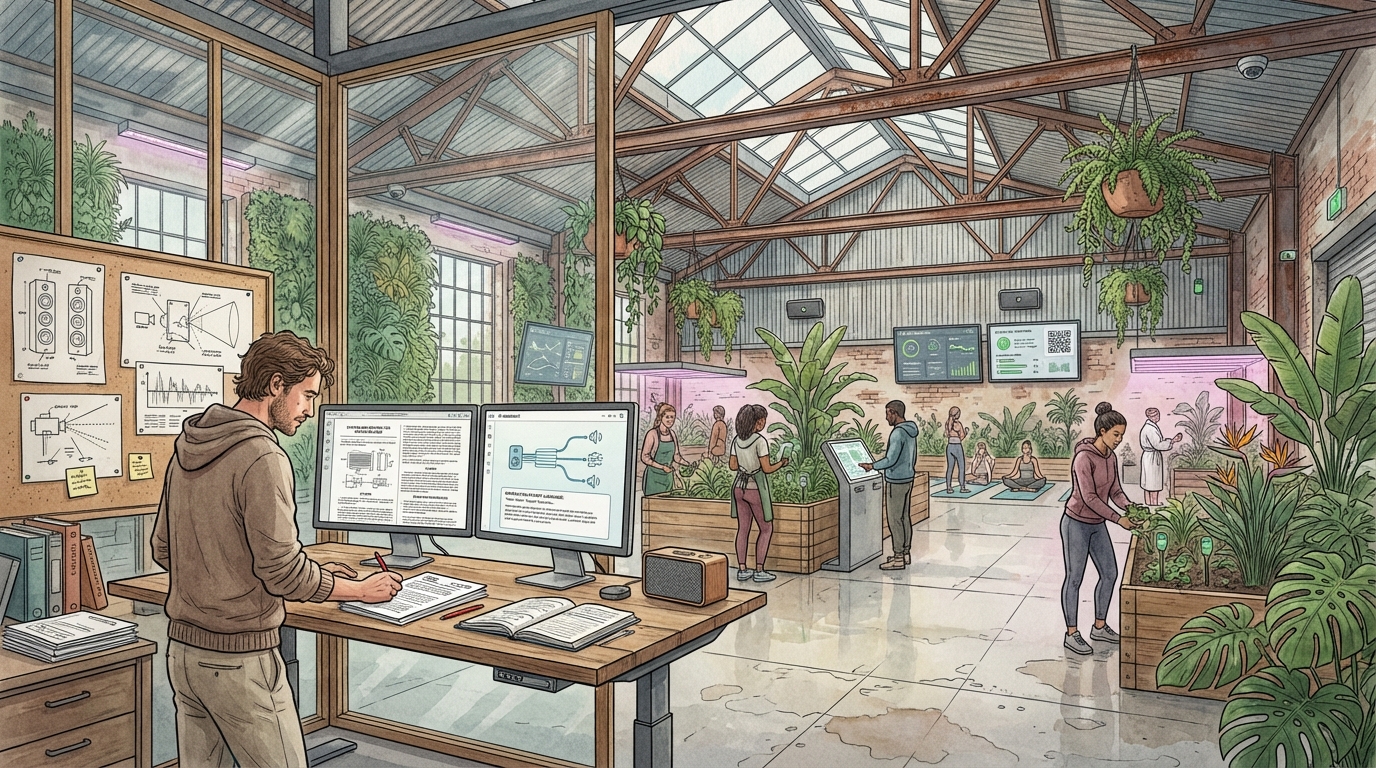
A place-based social club fusing gardening, fitness, thermal wellness, and community — all orchestrated by a native AI platform built from day one.
Concept
What Is Sponic Garden?
Sponic Garden is a growth and wellness-oriented social club designed for an era of increasingly powerful agentic AI capabilities.
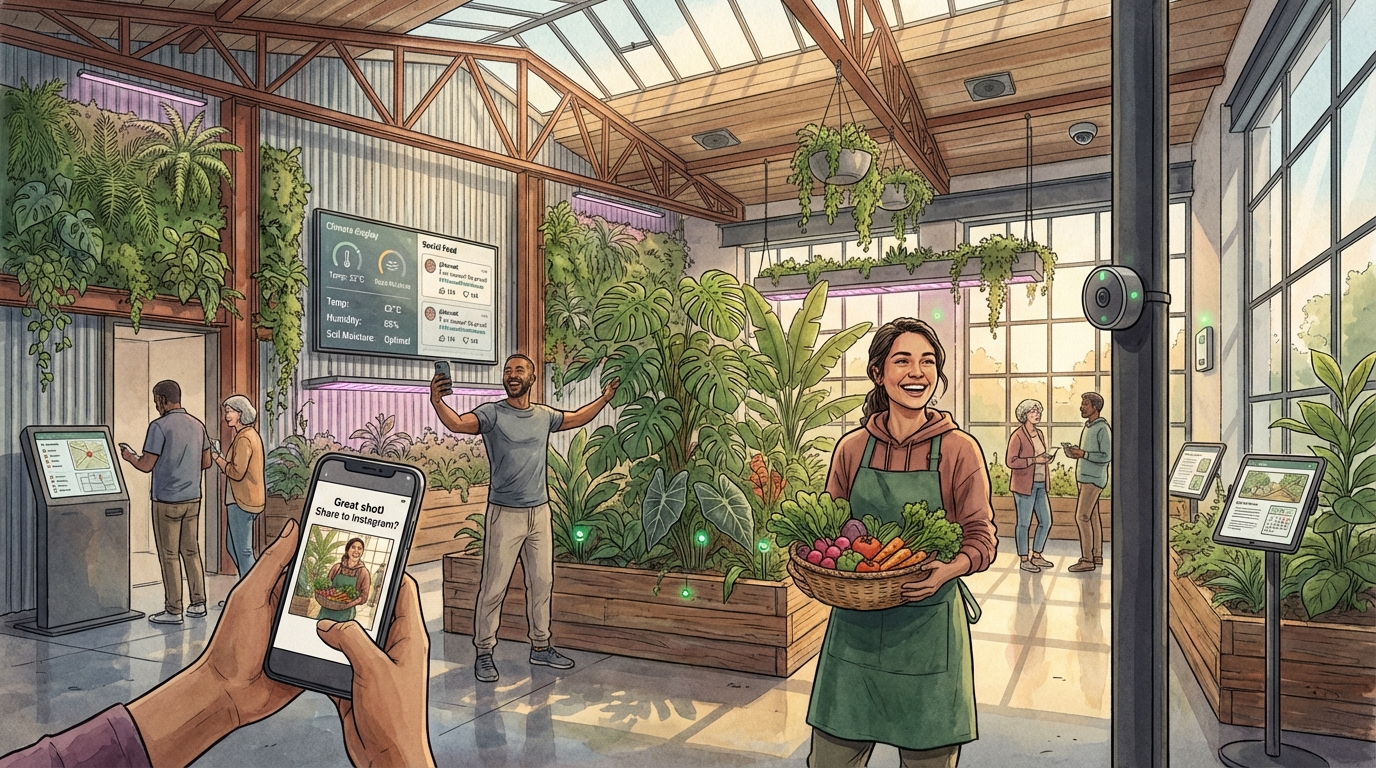
The thematic center of Sponic Garden is plant cultivation and gardening — chosen for a variety of reasons: 1) gardening is a generally healthy and fulfilling activity, 2) it can be done socially in groups, 3) it is well suited for management by AI, sensors, and photo tracking, 4) aspects of botanical cultivation can be amazingly photogenic and thus helpful in member engagement & marketing activities, and 5) gardening has appeal across various age groups.
But the experience is designed to extend into fitness, thermal bathing, music, community food, artisan vending, and continuous learning. As such it is an economically efficient micro-scale health and educational resort. While this is a very broad range of activities, the thesis of Sponic Garden is that AI can be used to manage almost every aspect of the business — and in doing so can create radical efficiencies, and rapidly enhance product-market fit across a wide variety of dimensions faster than could ever be possible with human management of this type of endeavor.
The AI takes the guesswork out of a lot of business operations and decisions by enabling members to give constant feedback in a manner that allows for optimization around their health and satisfaction with the experiences of Sponic Garden. And the AI is designed to optimize for both human and botanical flourishing and cooperation.
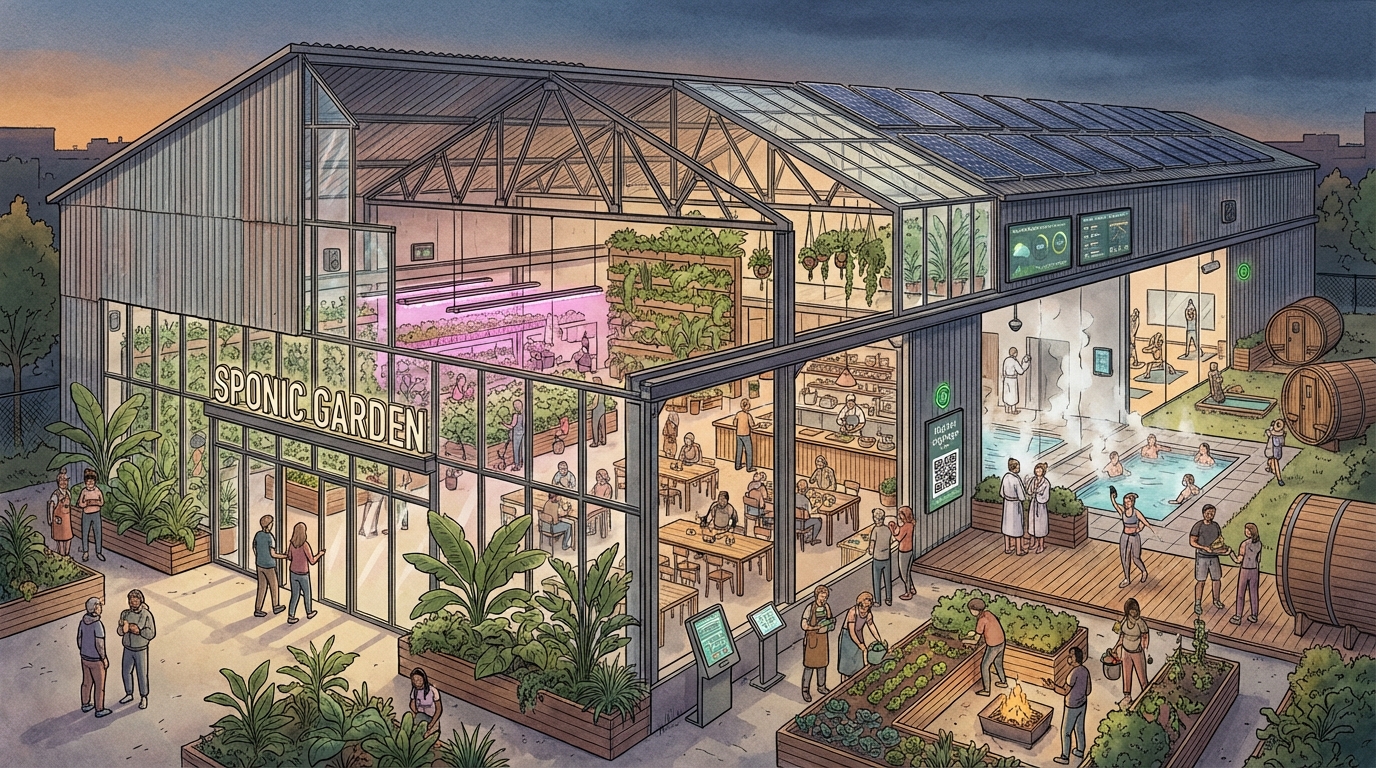
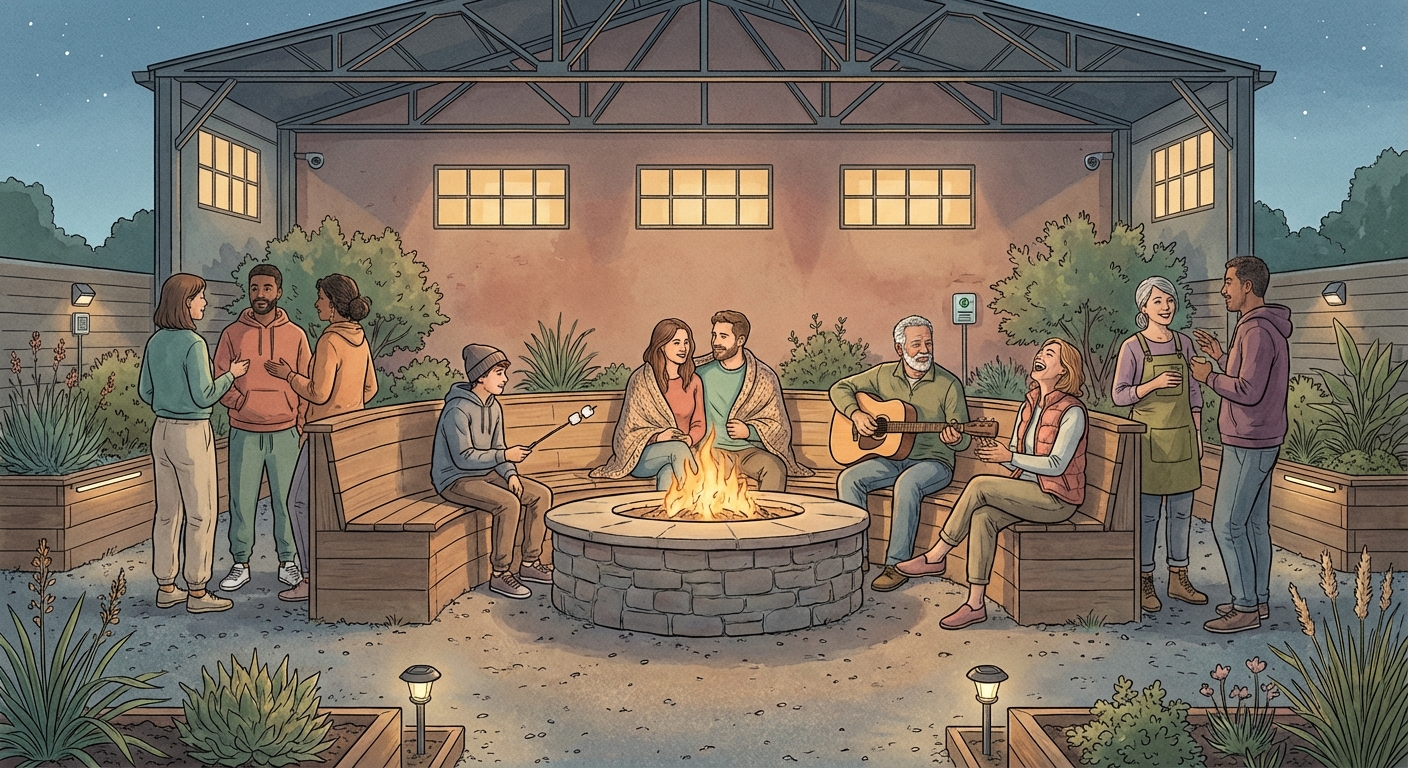
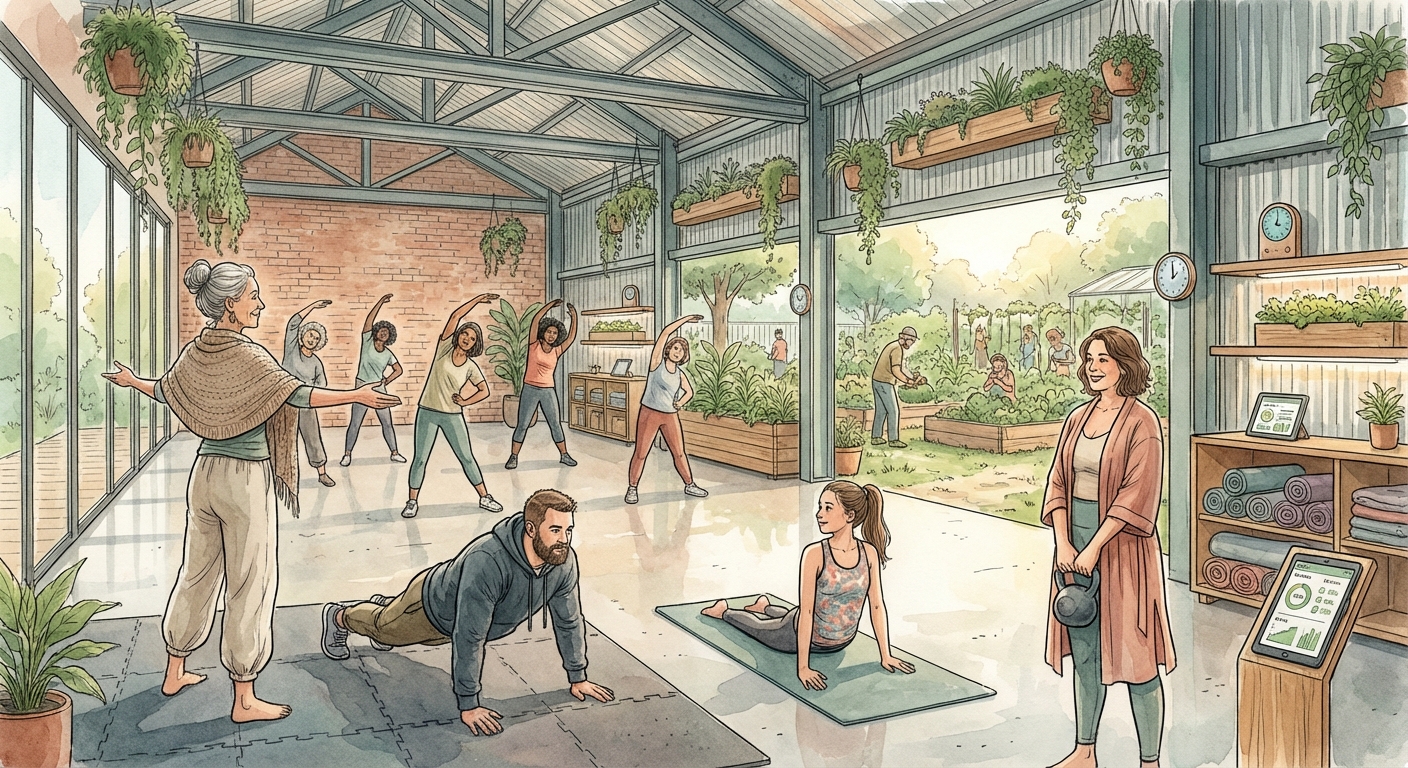
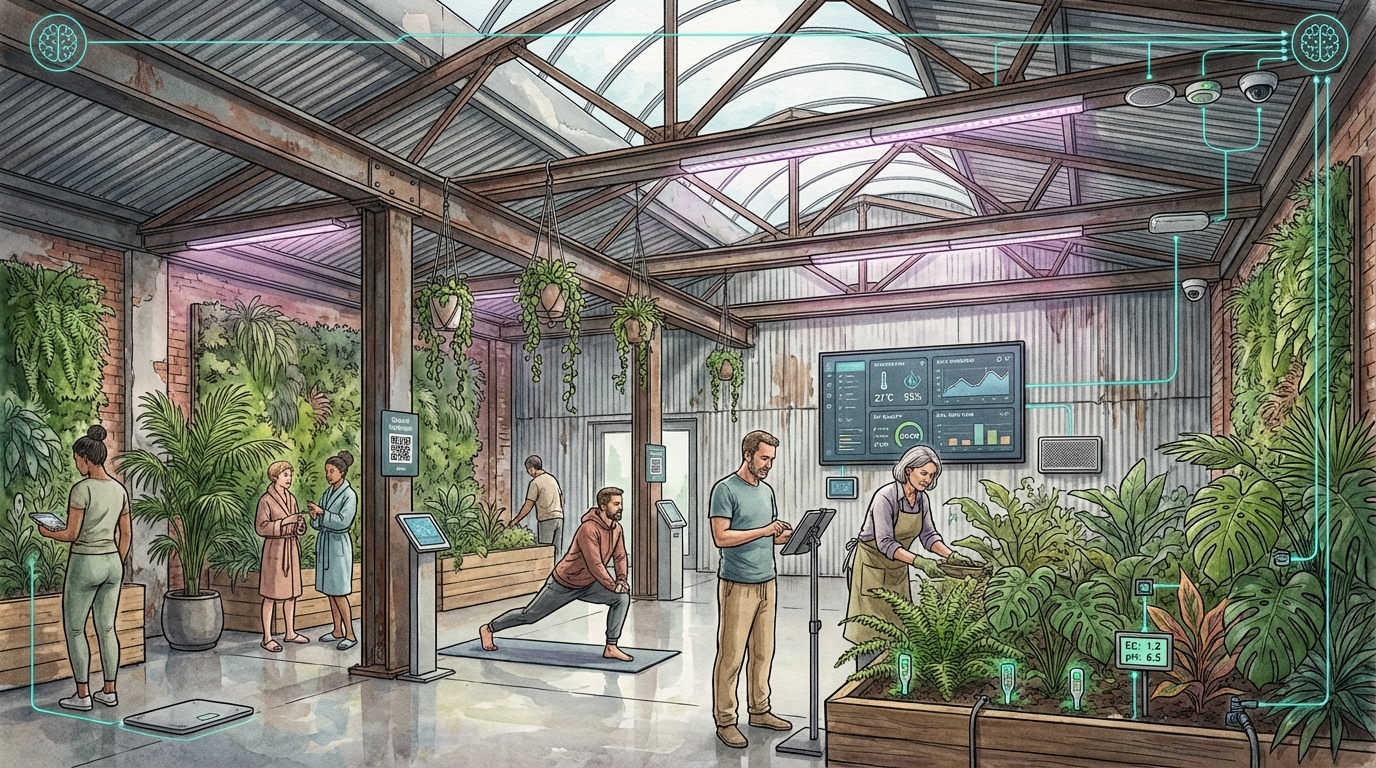
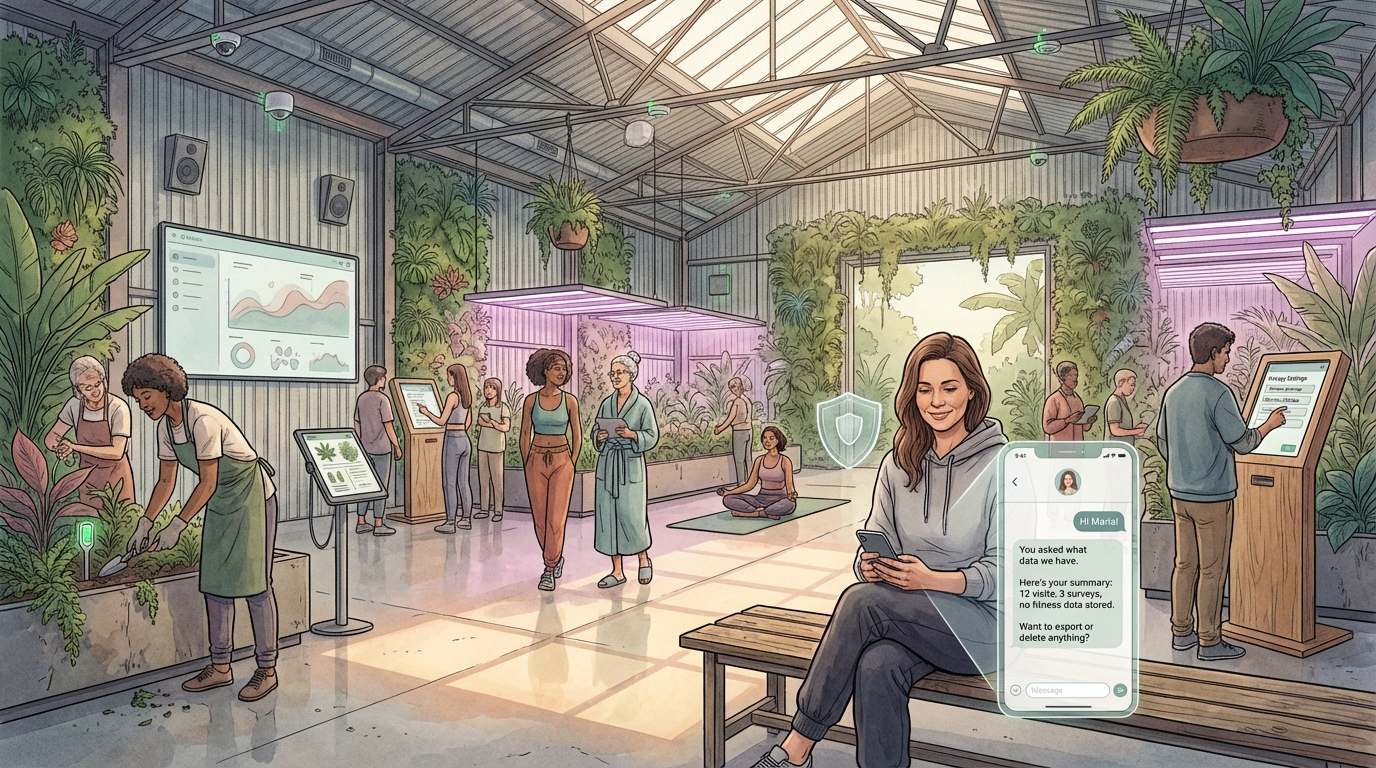
The Sponic Garden facility will be a custom-built indoor–outdoor warehouse-greenhouse hybrid filled with plants, great music, and people pursuing well-being together. It will be built from the ground up to be maximally AI-monitored and managed, while at the same time providing members with a digital agent that enforces their privacy rights and desires.
Ultimately Sponic Garden is an enabling framework for people to get the most benefit from their community, contribute to others' well-being, and drive growth across multiple dimensions.
The core design principle of Sponic Garden — what differentiates it — is that every system — from irrigation to event scheduling to food logistics — runs on a native AI platform. The facility is a living lab where AI doesn't assist operations — it is the operating system.
Think: a greenhouse that learns. Every sensor reading, every member interaction, every plant measurement feeds a single intelligence that gets better daily.
The Charter — 7 founding principles: contribution as currency, embrace new tech, protect privacy, promote health, educate, optimize through community voice, start with givers.
Four Pillars
The Experience
🌱 Gardening & Cultivation
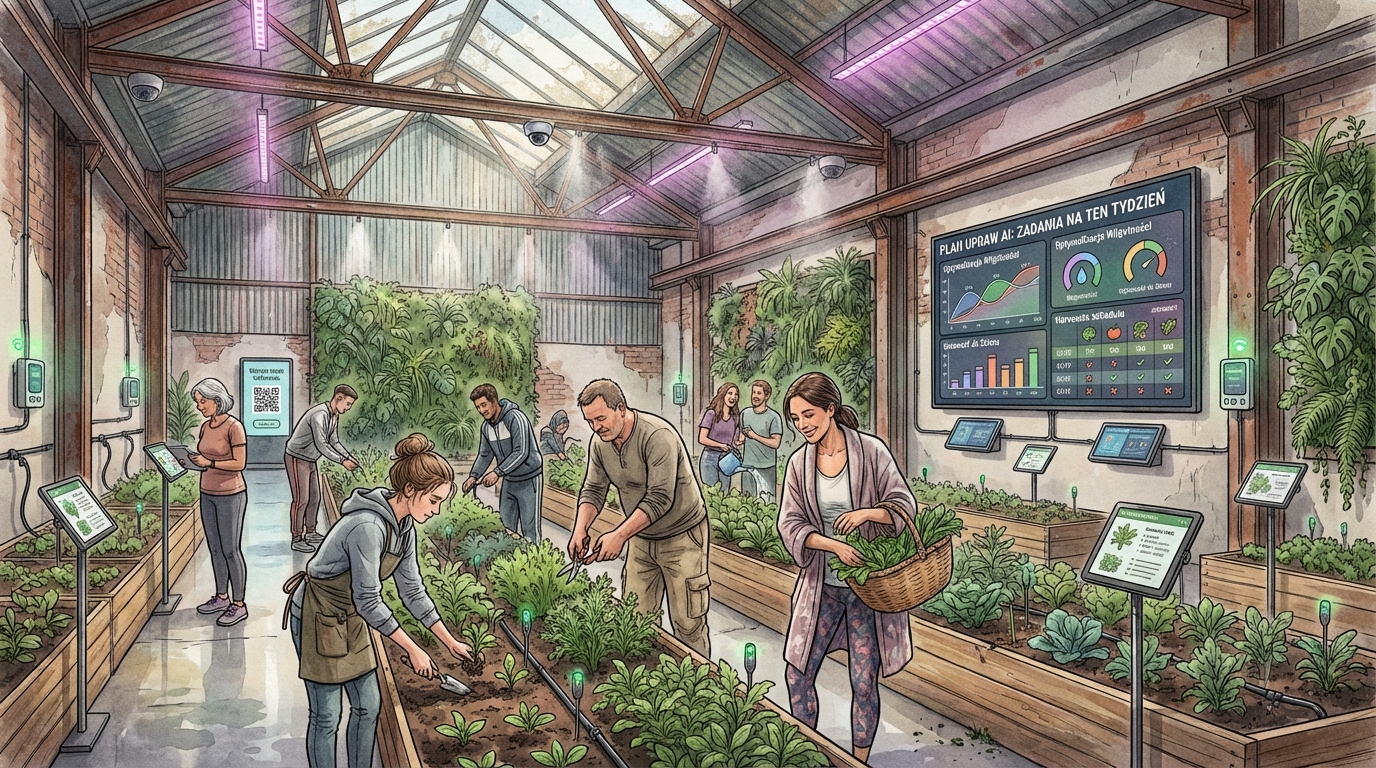
Members participate in guided gardening sessions — planting, cultivating, harvesting. The AI manages the cultivation plan, enlisting members to decide what to plant, how to care for it, and what to do with the produce.
Why gardening is the anchor
Gardening is inherently therapeutic, communal, productive, and measurable. It gives people a reason to return, a rhythm to follow, and something tangible to show for their time. The harvested produce flows directly into the on-site food service — closing the loop from soil to plate.
🏆 The Garden Show — gamified cultivation
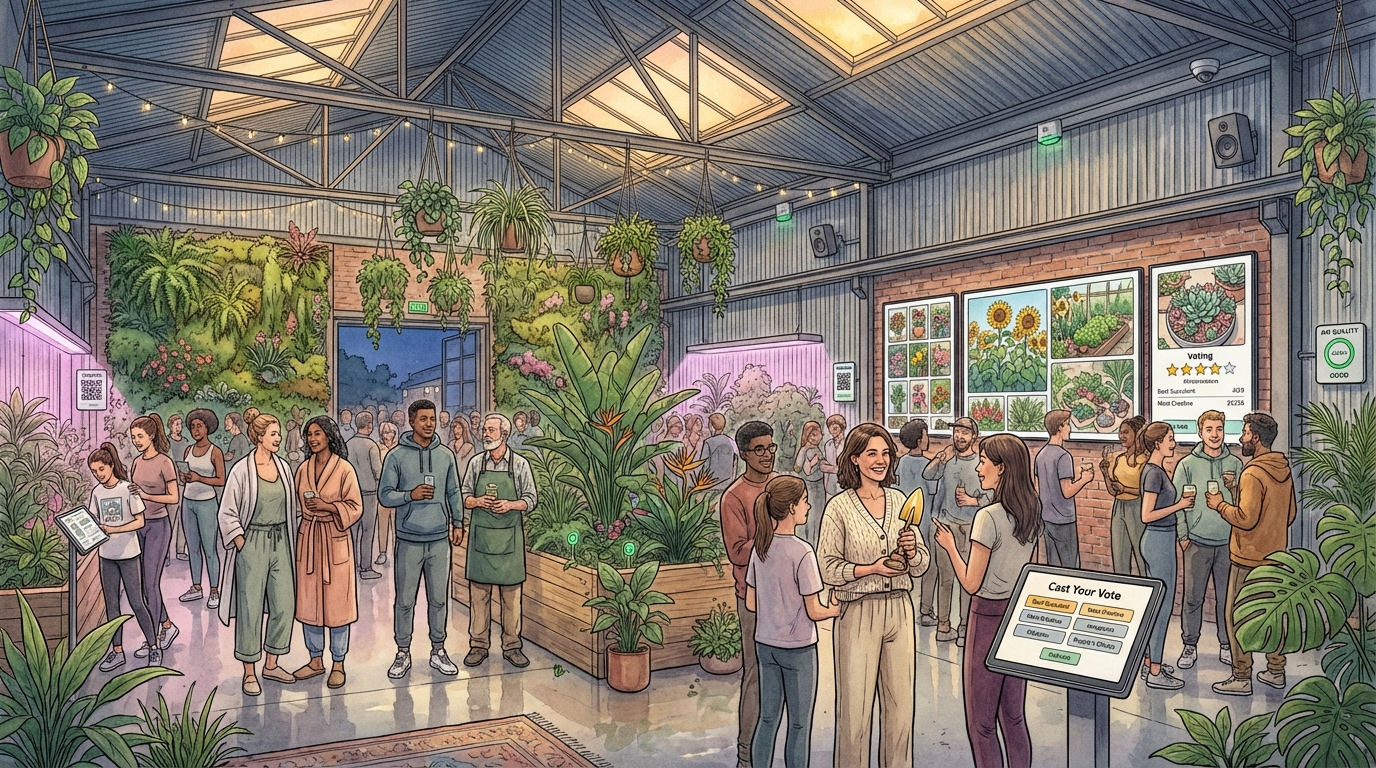
Gardening at Sponic Garden isn't just therapeutic — it's competitive and celebratory. Members photograph their creations throughout the growing cycle, building a visual portfolio of their work. On a regular cadence, the community hosts The Garden Show:
How it works: Members submit photos of their best plants, arrangements, harvests, or creative garden projects via the app. All submissions are displayed on the facility's video screens and in a digital gallery. The community votes — each member gets a limited number of votes to cast across categories. Top entries win prizes: free visit passes, premium workshop access, featured vendor collaborations, or "Golden Trowel" recognition displayed at the facility.
Categories rotate seasonally — tallest plant, most creative arrangement, best herb garden, biggest harvest yield, most improved plot, best team project. The AI tracks participation, suggests categories based on what's growing, and surfaces trending entries to keep engagement high.
The result: a built-in social loop that makes members want to cultivate, document, share, and return — turning gardening into a community sport with real stakes and real pride.
📸 AI-powered social media
The AI identifies photo opportunities throughout the facility — a plant hitting a growth milestone, a stunning arrangement, golden-hour light in the greenhouse, a member's first harvest. If the member opts in, the AI captures or prompts the moment, applies on-brand framing, and offers one-tap sharing to their social channels.
Posts are automatically distributed and measured — the AI tracks engagement (likes, shares, reach), learns what content resonates, and refines its photo-op suggestions and timing. Members build a visual journal of their cultivation journey; Sponic Garden gets authentic, member-generated marketing at scale. The entire social media strategy — content identification, capture prompts, distribution, and performance analytics — is AI-managed.
🏋️ Fitness
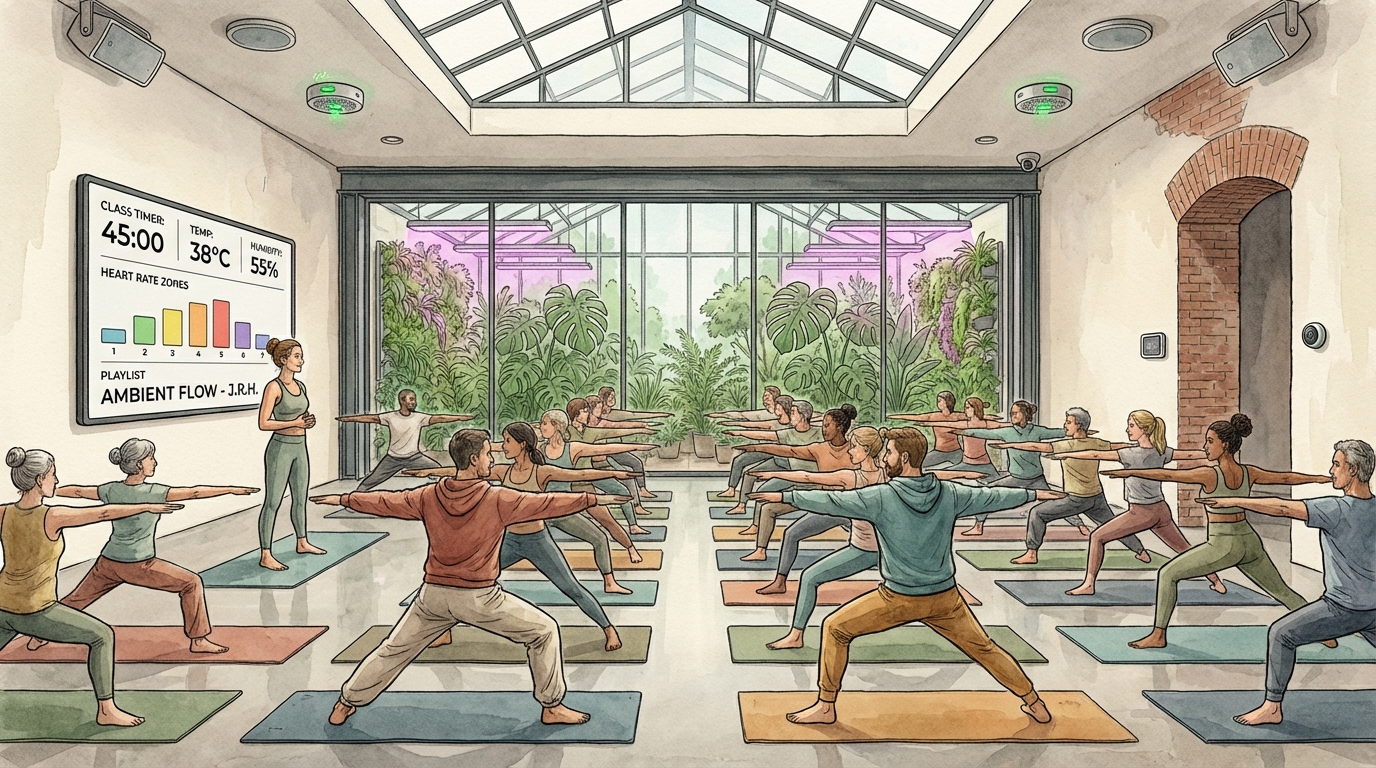
30-person hot yoga studio
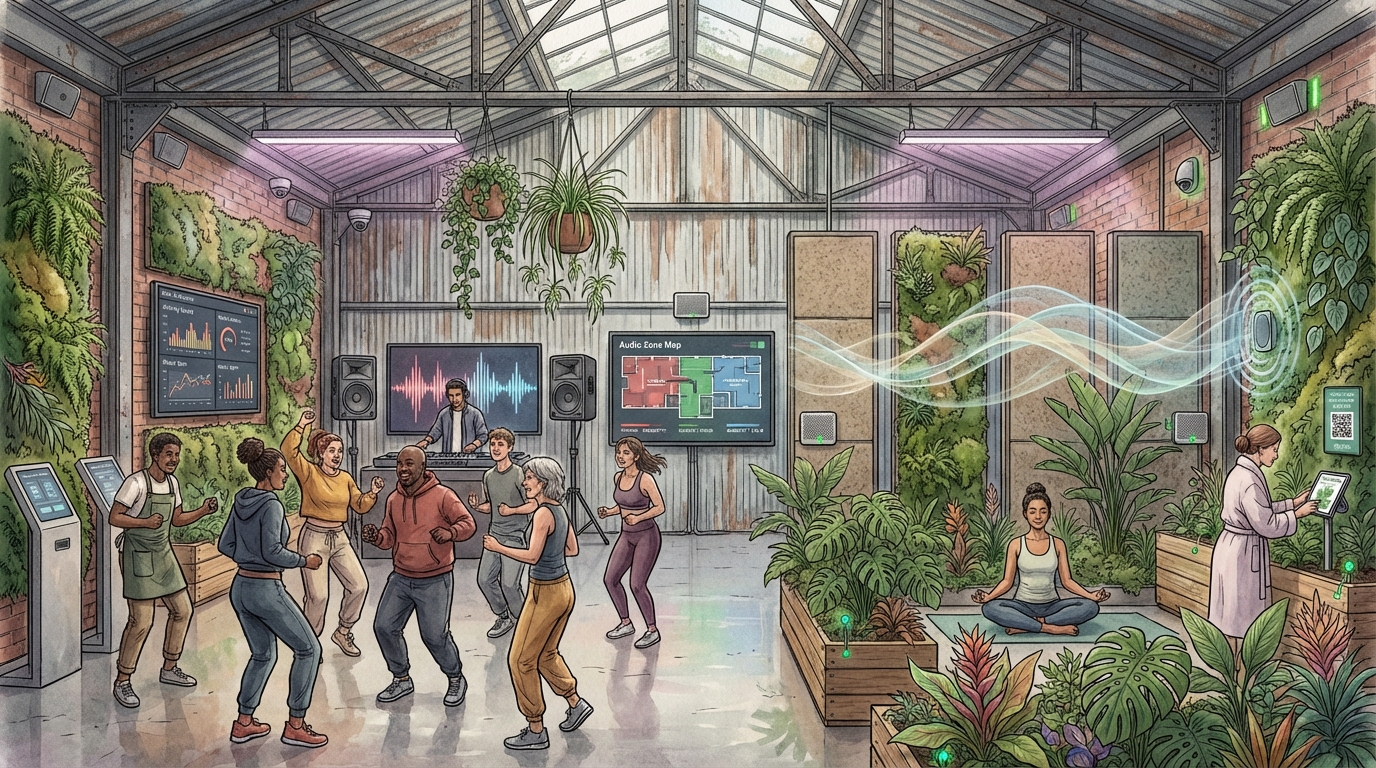
30-person dance studio
Open movement & congregation areas (indoor + outdoor)
AI schedules classes, allocates instructors, and sets per-class music/lighting presets. Opt-in fitness device data (HR, recovery — anonymized) helps tune intensity.
🧖 Thermal & Spa
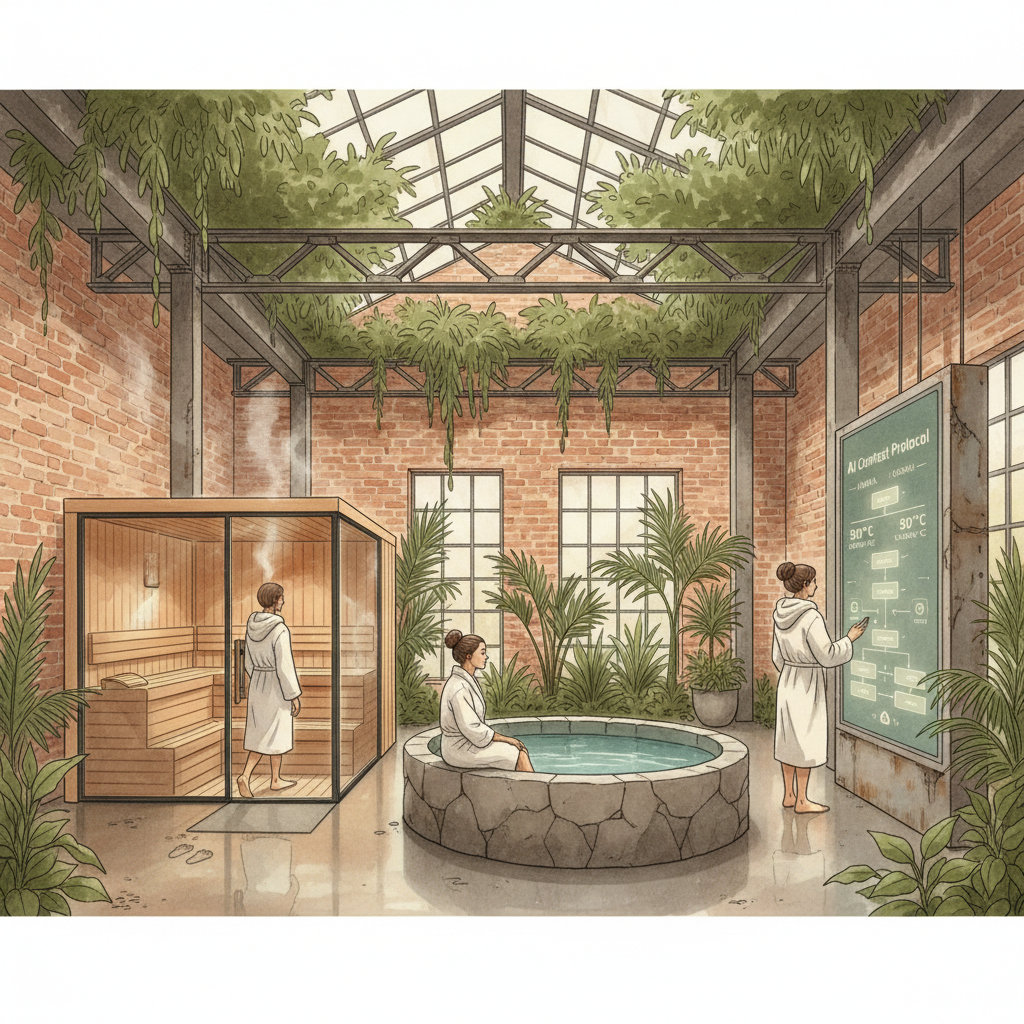
2 saunas · 1 steam room
2 cold plunges · 1 hot tub · 1 cool pool
AI-guided contrast therapy
The AI suggests personalized contrast protocols — sauna→cold plunge→hot tub sequences based on aggregated anonymized data. It manages temperatures, session timing, and capacity gating per unit, while water quality and hygiene sensors run continuously.
🎵 Music & Atmosphere
Pervasive, high-quality sound systems throughout — curated playlists and live sets for both human enjoyment and plant stimulation. AI-controlled audio zones adapt to activity, time of day, and crowd energy.
How the AI reads the room
Audio-level sensors per zone measure crowd energy — conversation density, laughter, movement intensity — without recording content (privacy-first). The AI correlates these signals with occupancy and activity type to curate the right vibe: calming in spa zones, energizing in dance, focused in gardening.
Food & Drink
Crowd-Sourced Food Service & Artisan Vending
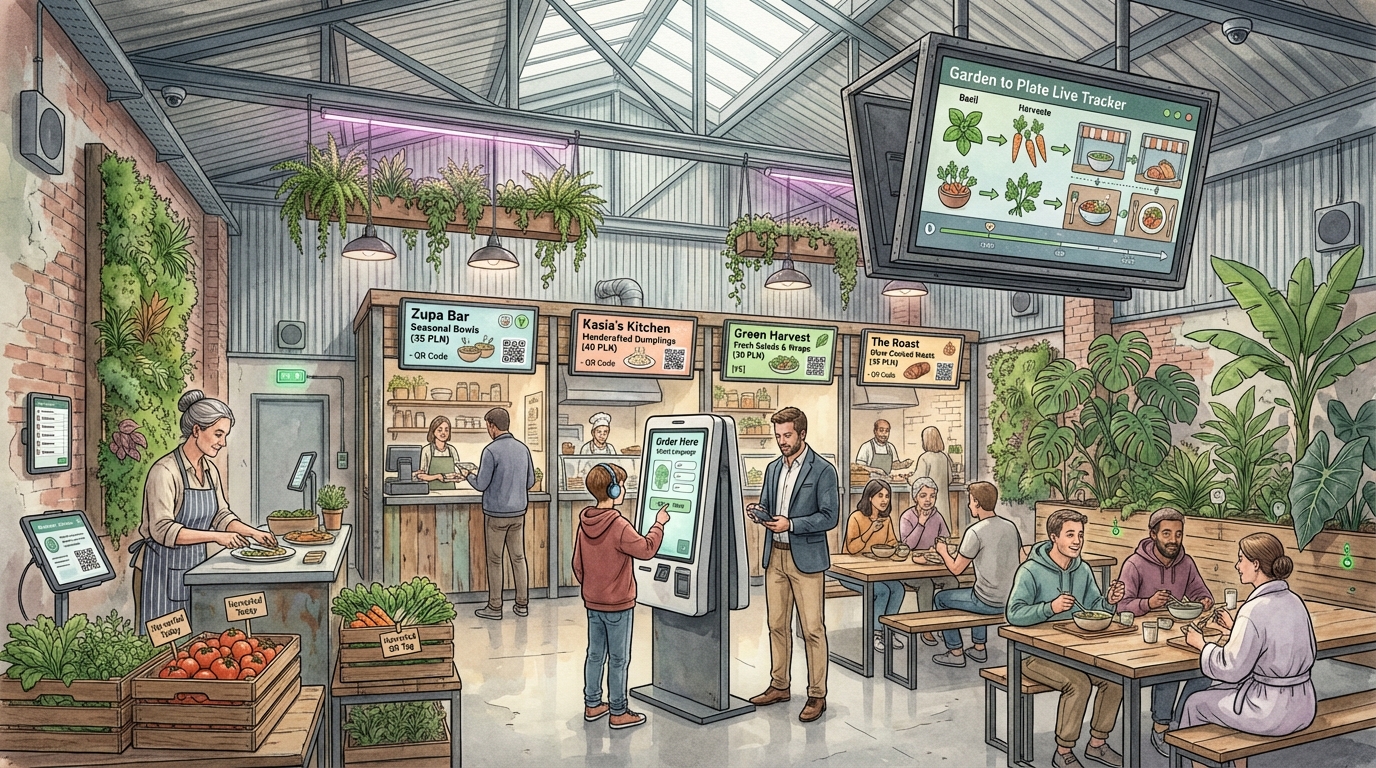
Food and drink is crowd-sourced from the local community. Sponic Garden provides artisan vendors with everything they need: equipment, serving containers and utensils, billing infrastructure, marketing, and on-site delivery logistics — all optimized by AI. The facility becomes a platform that lowers the barrier for local food entrepreneurs while giving members diverse, fresh options.
Beyond food, the marketplace extends to artisan vendors — handmade jewelry, clothing, crafts, and wellness products. The same infrastructure that supports food vendors (billing, marketing, scheduling) powers a rotating market of local makers, turning Sponic Garden into a vibrant community bazaar.
AI tracks sales data, consumption rates, waste levels, queue lengths, and member ratings to optimize vendor scheduling, menu composition, and portioning.
Garden-to-plate pipeline & member input
Produce harvested during gardening sessions flows directly to on-site vendors — closing the loop from cultivation to cuisine. Members vote on future vendors, suggest produce varieties, and rate dishes. The AI correlates food choices with wellness outcomes (via opt-in health data) to nudge menus toward ingredients that demonstrably improve how members feel.
Core Technology
AI-Native Platform
The AI platform is the foundation — not a bolt-on. It powers member-facing digital interfaces, on-site event management agents (calendaring, directing, announcing), and educational sessions from beginner gardening to complex horticulture and wellness science.
The goal: natively design a facility where everything can be cohesively managed by AI, given the most data-rich feedback mechanisms possible — from physical sensors to digital monitoring to human surveys.
Architecture
The Central Nervous System
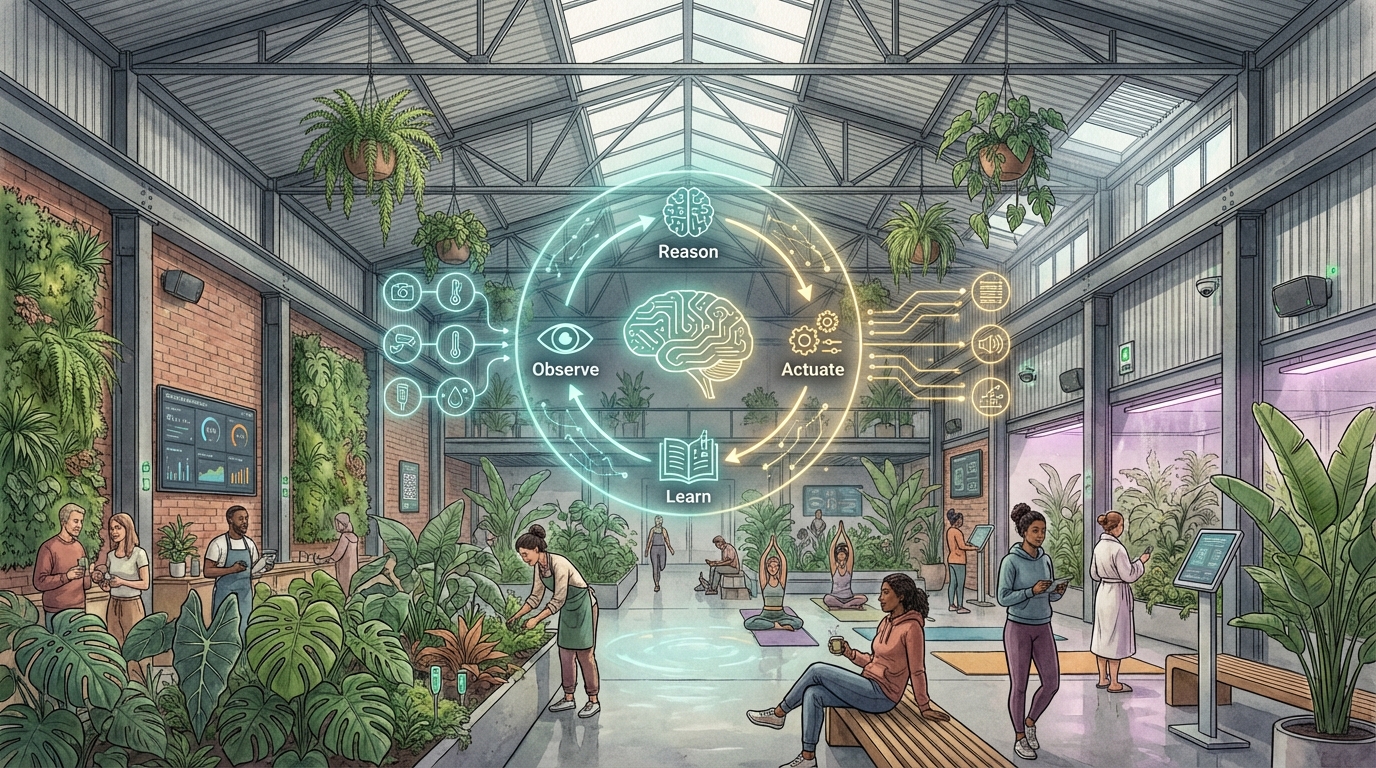
The AI operates as a closed-loop control system — continuously observing, reasoning, and actuating across every domain, then learning from the results.
How reinforcement learning drives continuous improvement
The AI treats sensor data as proxies but grounds optimization in human-perceived value. It correlates environmental patterns (specific lighting + music + temperature combinations) with high-value survey responses, then reinforces those states. It runs small experiments — slight variations in one variable at a time — and measures impact. Over weeks and months, the system converges on configurations that demonstrably improve member well-being, plant health, and operational efficiency.
During the early prototype phase, human experts remain in the loop — gardeners, wellness professionals, and facility operators validate AI decisions and provide training signal that pure sensors can't capture.
AI Systems Map
What the AI Controls & How It Learns
Every controllable system is paired with feedback mechanisms. Click any system to see what the AI controls and how it measures results.
Plant Systems
💧IrrigationMax yield per liter
AI Controls
Watering schedules, zone flow rates, nutrient dosing, hydroponics management
Feedback Full
Soil moisture & EC/pH sensors, soil temp, humidity, plant growth cameras, water flow meters, harvest yield data, member planting input
💡LightingPhotosynthesis + circadian
AI Controls
Spectra, intensity, schedules per zone — grow LEDs, circadian mood lighting, entertainment lighting
Feedback Full
PAR/lux sensors, multispectral cameras (leaf color/stress), occupancy heatmaps, time-of-day, energy usage, member comfort surveys
Social engagement metrics (likes, shares, reach, saves), member opt-in rates, content performance by type/time/platform, referral tracking, new member attribution
Autonomous Optimization
The Experiment Engine
The AI operational management agent runs a closed-loop control system — sensors feed data, explicit feedback (surveys, votes) and implicit feedback (motion patterns, visual sentiment detection) drive an optimization process. Inspired by autoresearch, the system continuously runs small, safe experiments across every domain of the facility.
🔄 The Loop: Modify one variable → run for a fixed time window → evaluate the metric → keep or revert → repeat. Over weeks, the AI autonomously discovers winning combinations — without anyone manually tuning.
Evaluate: Growth rate, yield, member "Garden Show" votes
Result: Autonomous plant optimization — the AI is the geneticist
🧬 The Meta-Pattern: Champion / Challenger = Autoresearch
The existing charter pattern — one champion (current winner) + two challengers (alternatives people can vote as better) — is autoresearch applied to community decisions. The key formalizations:
Fixed evaluation windows — not open-ended
Single-variable changes — test one thing at a time
The facility becomes a living experiment that optimizes itself — exactly the AI-native vision, with a proven engineering pattern for how the iteration loop works.
Success Metrics
What the AI Optimizes For
Five domains drive every AI decision. The system continuously balances these — a lighting change that boosts plant growth but drops comfort surveys gets rolled back.
App analytics, booking data, sales data, vendor performance, attendance, engagement metrics, recommendation click-through, energy usage — every digital interaction is a data point.
🗣️ Human Layer
Contextual micro-surveys — quick pulse checks letting members convey value received. Plus opt-in fitness device integration for anonymized health tracking.
The optimization loop
The AI correlates sensor patterns (e.g., specific lighting + music + temperature at 3pm in the garden zone) with high-value survey responses and reinforces those states. Sensor data provides the what; human surveys provide the value ground truth that pure sensors can't capture.
Trust & Compliance
Your Data, Your Agent
Operating under EU GDPR, Sponic Garden doesn't just comply — it gives every member an AI-powered privacy agent that makes exercising your data rights as easy as asking a question.
🤖 Your Privacy Agent
Every member gets a personal AI agent that can instantly answer: "What data do you have on me?", "Delete my visit history from last month", "Export everything you know about me", "Stop using my fitness data for recommendations." The agent executes GDPR rights in real-time — no forms, no waiting, no support tickets.
Full GDPR rights — all agent-accessible
Right to Access (Art. 15) — Ask your agent to show all data collected about you: visit history, survey responses, booking patterns, fitness data, food preferences. Delivered in a readable dashboard, not a PDF dump.
Right to Erasure (Art. 17) — Request deletion of any or all personal data. Your agent confirms what will be deleted and executes immediately. Aggregated, anonymized data (which cannot identify you) is retained for system learning.
Right to Portability (Art. 20) — Export your complete data profile in a standard machine-readable format (JSON/CSV). Take your gardening history, wellness trends, and preferences to any other service.
Right to Restrict Processing (Art. 18) — Pause specific data uses without deleting. Example: "Keep my data but stop using it for personalized recommendations."
Right to Object (Art. 21) — Opt out of any specific processing at any time. Your agent shows you exactly what each data stream is used for and lets you toggle each one individually.
Right to Explanation (Art. 22) — Ask your agent why the AI made any recommendation. "Why did you suggest this class?" "Why was this music playing?" The system provides a human-readable explanation of the inputs and reasoning.
How we collect — granular consent controls
Tiered consent model: During onboarding, members choose their data sharing level — from "minimum" (anonymous occupancy only) to "full" (personalized recommendations, fitness integration, health insights). Every tier is fully functional; more sharing unlocks more personalization, but less sharing is never penalized.
Camera systems use on-device edge processing for occupancy counting and flow analysis. No facial recognition. No individual tracking. Raw video is never stored — only aggregate counts leave the device.
Audio sensors measure ambient energy levels (volume, density) only. Content is never recorded. Members can verify this via their privacy agent at any time.
Fitness device data is opt-in, encrypted in transit, and stored pseudonymized. Members can revoke access and trigger deletion instantly via their agent.
Surveys are anonymized at the point of submission. Individual responses are never linked to member profiles unless the member explicitly chooses identified feedback.
Infrastructure & compliance
Data minimization: Each system collects only what it needs. Retention periods are set per data type and automatically enforced — visit logs (12 months), survey responses (aggregated after 30 days), fitness snapshots (member-controlled).
Appointed DPO: A dedicated Data Protection Officer oversees compliance, conducts regular audits, and is reachable via the member app.
Breach notification: In the unlikely event of a data breach, affected members are notified within 72 hours via their preferred channel, with plain-language explanation and remediation steps.
Vendor DPAs: Every food vendor, instructor, and third-party service signs a Data Processing Agreement. Member data never leaves the Sponic Garden platform without explicit consent.
Physical Space
The Facility
Custom-built in an indoor–outdoor warehouse/greenhouse hybrid, equipped with:
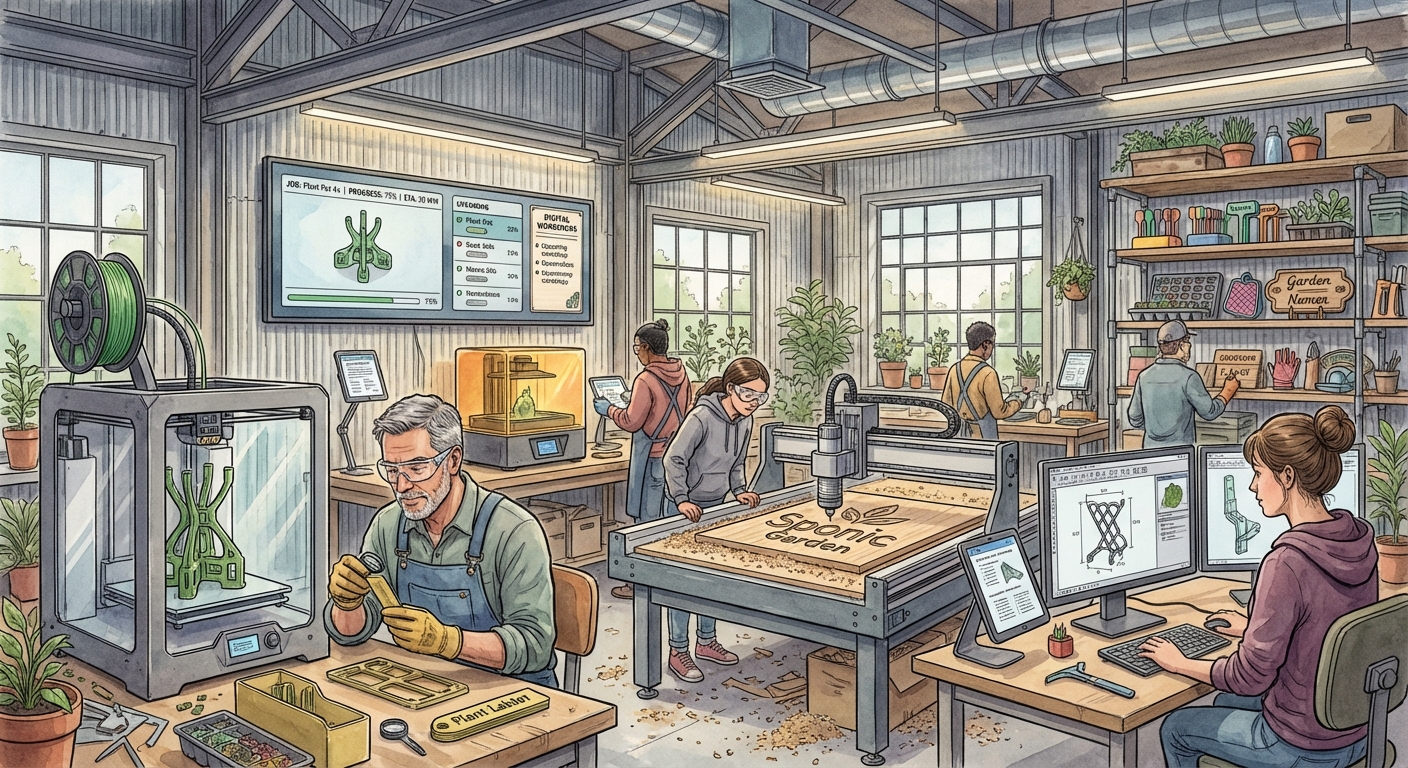
A dedicated fabrication area equipped with 3D printers (FDM and resin), CNC routers, and design workstations. Members create custom garden infrastructure, signage, plant markers, and functional tools.
🌿 3D-Printed Garden Infrastructure
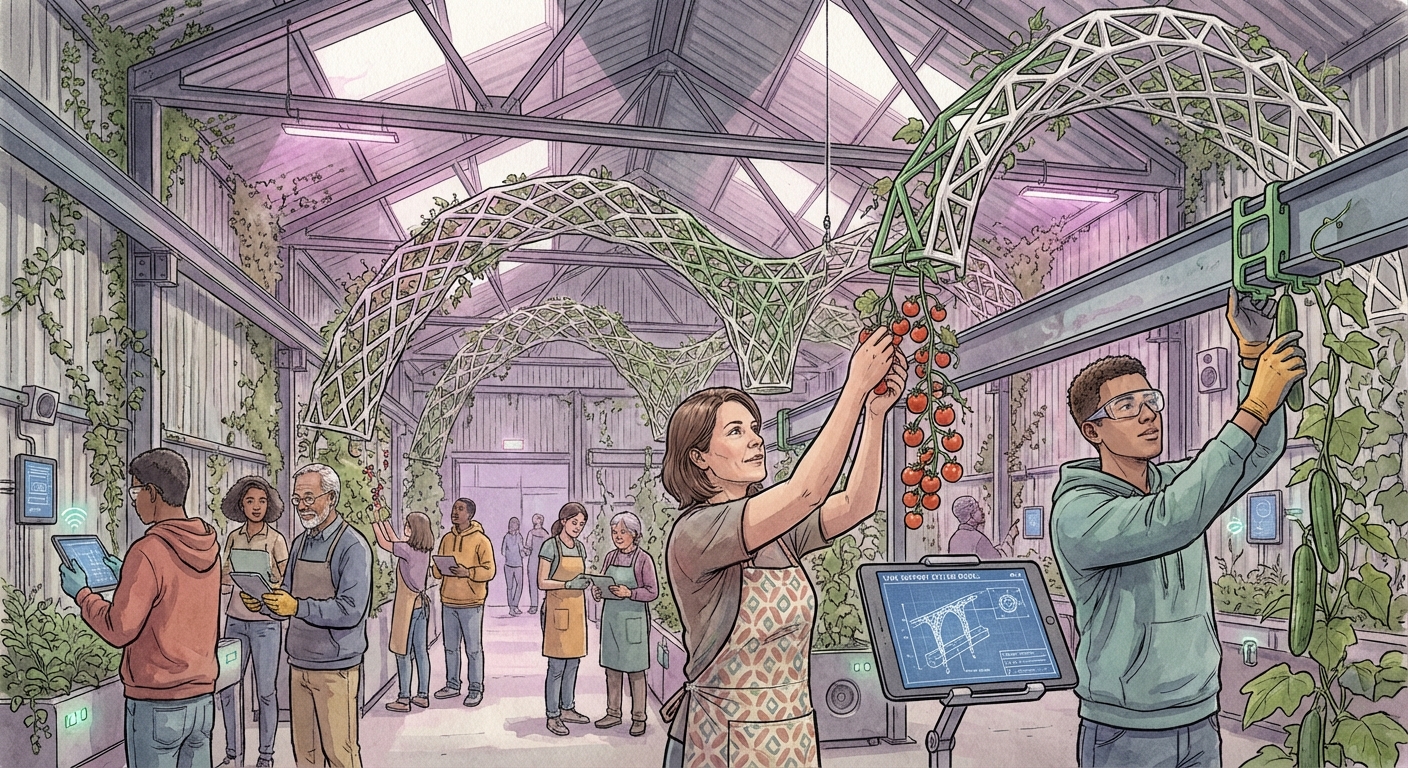
Custom lattice brackets, vine support clips, and hanging planter frames are 3D-printed and installed throughout the growing zones. Climbing vines and trailing herbs grow through geometric frameworks suspended from the warehouse's steel trusses — creating living green canopies.
🔧 What Members Make
Custom vine trellis brackets and plant clips
Hanging planter frames from steel trusses
CNC-carved wooden signs and wayfinding markers
Seed tray inserts and propagation components
Sensor housings and IoT enclosures
Decorative plant labels and Garden Show trophies
Business Model
Membership & Pricing
Structured like a sports club or yoga studio — membership-based with à la carte offerings.
💳 Pricing (Prototype)
€40 — admission for 1 to 4 hours
€10 — per additional hour
À la carte classes, workshops, and premium experiences
Food & drink purchased separately from on-site vendors
Launch Plan
Warsaw Prototype — July 2026
🚀 Phased Rollout
Phase 1: Launch with cohorts of 64 founding members. Core loops only — plants + music + one fitness studio + spa zone. Human experts in the loop for all AI decisions.
Phase 2: Expand capacity as systems stabilize and AI learns from real data. Add full fitness wing and food vendor program.
Phase 3: Scale to full 250-person prototype capacity with autonomous AI optimization.
Warsaw chosen for vibrant wellness culture, affordable operational costs, and growing international community.
Sensor deployment strategy
Start with high-ROI sensors: temperature, humidity, soil moisture, cameras (for occupancy + plant vision), and audio-level sensors. These use commodity hardware (Zigbee/ESP32/Home Assistant-compatible stacks) and deliver the most actionable data per euro.
Phase 2 additions: VOC/particulate air quality, multispectral plant cameras, water flow meters, waste sensors. These require more specialized hardware but unlock deeper AI optimization.
Phase 3: Full sensor mesh — EC/pH probes, PAR sensors, per-plunge water quality, energy sub-metering. By this point the AI has enough training data to extract maximum value from granular sensor input.
Intellectual Property
AI-Automated Patent Generation
The AI platform generates intellectual property emerging from its novel innovations. Agents can review prior art and determine when there are patent ideas with genuine protective or financial potential, and then automatically file $65 US provisional patents. System designs and novel algorithms are automatically documented into patent-ready specifications.
📄 A System for Vision Driven Sonic Landscape Selection
Our first patent: an adaptive ambient audio system using computer vision for real-time audience detection, behavioral feedback analysis, and gesture-based control.
Most wellness concepts treat technology as an afterthought — a booking system bolted onto a spa. Sponic Garden inverts this: the AI platform is the foundation, and the physical space is designed around what AI can measure, optimize, and learn from.
The result is a place where plants and people flourish together, where every element of the environment — light, sound, temperature, soil, food, activity — is being continuously tuned by an intelligence that gets better every day.
Sponic Garden is not a gym with plants. It's not a co-working space with a sauna. It is a new category: an AI-native social club designed from the ground up to promote human and botanical flourishing.